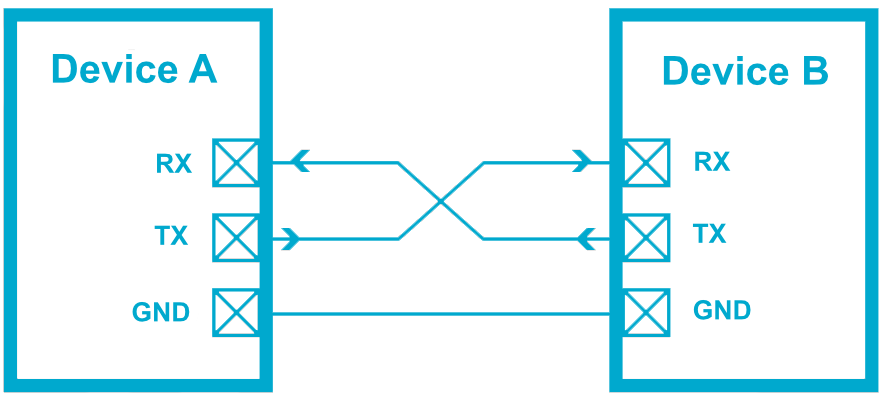
UART Protocol
What is the UART Protocol?
The UART protocol is a serial communication protocol that allows data to be transmitted between two devices over 1 or 2 wires. It is commonly used in embedded systems and microcontrollers.
The way it works is by sending a start bit, followed by 8 data bits, and then a stop bit. The start bit is a low signal that indicates the beginning of a data frame. The data bits are the actual data being transmitted. The stop bit is a high signal that indicates the end of a data frame.
The line at idle is left high so that it is easier to detect a faulty wire/connection.
More modern protocols like SPI and I2C are also commonly used in embedded systems, both with their advantages and disadvantages. UART is a more simple protocol that takes less wires and is easier to implement but has its drawbacks like both devices must already be configured with the same baud rate.
Duplexes
There are 3 types of duplexes which dictate the direction and timing of data transfer between 2 devices.
- Simplex: Data only travels from one transmitter to one receiver.
- Half-duplex: Data can travel in both directions but not simultaneously.
- Full-duplex: Data can travel in both directions simultaneously.
Popular Open Source Licenses Explained Project Planning